Pattaya promises you’ll never be alone – so why are thousands of men experiencing crushing loneliness in the middle of it all?
You’ve seen the YouTube videos. Walking on the Walking Street at midnight. Soi 6 in the afternoon. Neon signs, cold Chang beer, beautiful women, and an endless parade of men who look like they’ve finally figured something out. Pattaya’s nightlife scene sells one thing above everything else: the promise that you will never, ever be lonely here.
But spend enough time talking to the long-term expats nursing their drinks at the same bar stool on a Tuesday afternoon, and a very different story begins to emerge. One thing they don’t put in the travel videos.
This is the Pattaya paradox, and if you’re planning a trip to Thailand’s most infamous beach city, understanding it might be the most important thing you read before you go.
What Actually Happens to Your Brain When You Land in Pattaya
To understand the loneliness phenomenon, you first need to understand what Pattaya does to your neurochemistry, because it does something remarkable, and not entirely in a good way.
Take a typical first-time visitor. He’s in his 40s or 50s, recently divorced, or just ground down by years of thankless work and a dating life that went nowhere. Back home, he’s invisible. Then he steps off a baht bus onto Soi 6, and within twenty minutes, attractive women are competing for his attention.
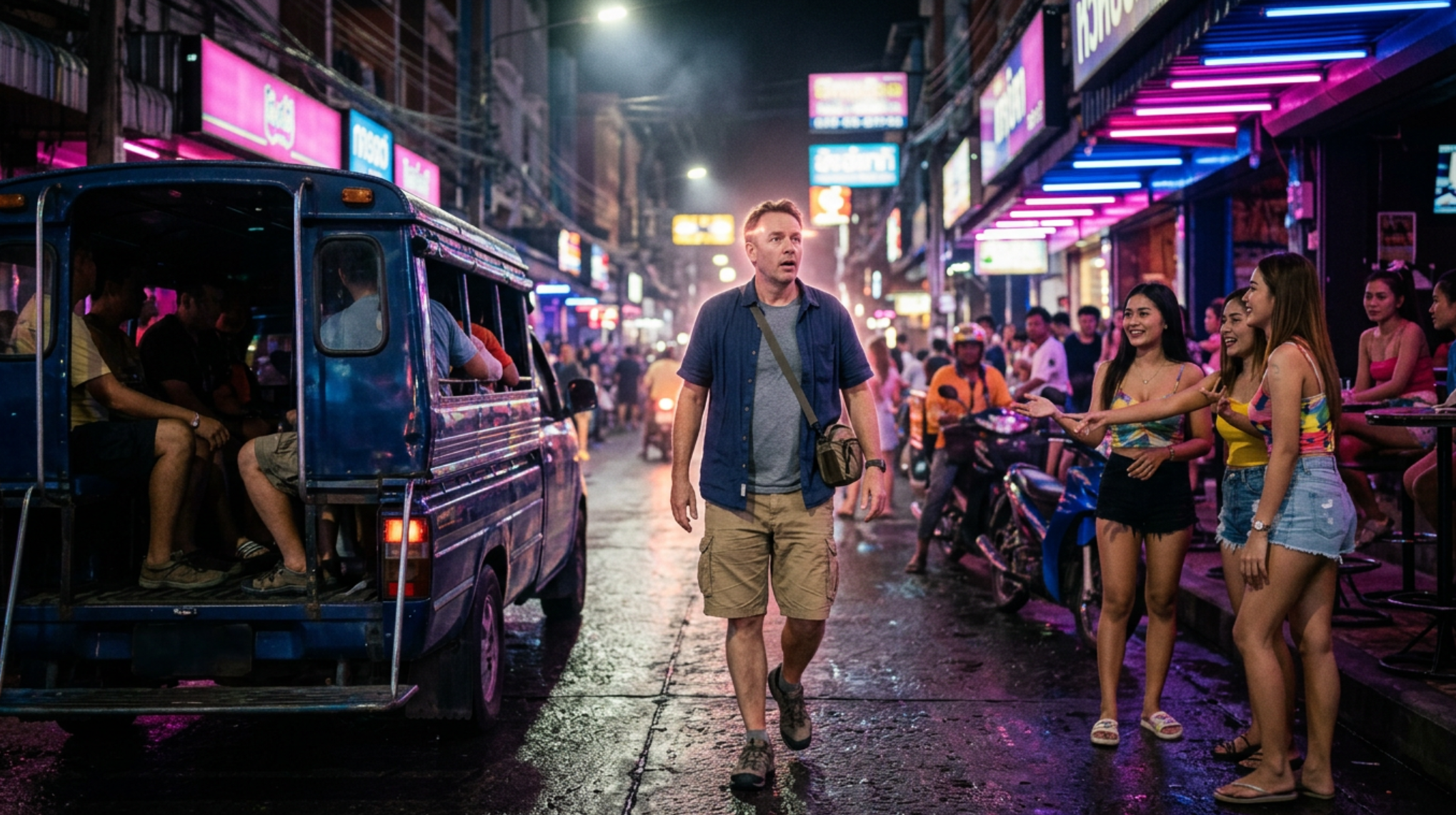
What he’s feeling isn’t love. It isn’t even an attraction in the traditional sense. It’s a massive dopamine surge, his brain’s reward system firing on all cylinders in response to social and sexual novelty.
Dopamine is widely misunderstood. Most people think of it as the “happiness chemical,” but neuroscientists are more precise: it’s the wanting chemical. Dopamine doesn’t make you feel satisfied. It makes you crave more. And herein lies the first trap.
Within days your brain recalibrates to this new, supercharged baseline. Psychologists call this hedonic adaptation, or the hedonic treadmill. That first night that genuinely blew your mind? By day seven, it’s routine. By week three, it’s barely registering. You find yourself chasing novelty compulsively, a new bar, a new girl, a new soi, and not because you’re greedy, but because your brain has been neurologically rewired to need escalating stimulation just to feel normal.
This is the mechanism behind how paradise becomes a prison. Normal life, both in Pattaya and back home, starts to feel unbearably flat.
The Transaction Problem: Why Pattaya bar girls can’t fix your loneliness
Let’s address the elephant in the room, because no honest article about Pattaya’s psychological landscape can avoid it.
The bar girl culture is the engine of Pattaya’s nightlife economy, and for many men, especially those arriving from emotionally barren lives, the experience of being desired, pursued, and genuinely fussed over feels nothing short of miraculous. After years of feeling unwanted, the attention is intoxicating.
But here’s the cognitive trap that trips up thousands of visitors every year: you are simultaneously experiencing the emotional cues of genuine connection while your logical brain knows it’s a commercial arrangement.
You’re receiving all the signals of intimacy, physical closeness, sweet words, apparent affection, and care. Your emotional brain responds to those signals exactly as it’s wired to. Your rational brain, meanwhile, is quietly noting the transactional foundation underneath it all.
This split creates what psychologists call cognitive dissonance, and living inside that contradiction is quietly exhausting. The need for authentic human connection doesn’t get met by the transaction; in many cases, it gets deeper, because the contrast between the performance of connection and real connection becomes more painfully obvious over time.
Thai culture has a saying that long-term Pattaya residents know well: no money, no honey. This isn’t a cynical observation; it’s simply a cultural and economic reality of how the industry operates. The men who struggle most are those who allow themselves to forget the terms of the arrangement, who hold onto the possibility that maybe this situation is different, maybe this girl genuinely fell for them specifically.
Sometimes real human warmth does develop. Shared time and genuine laughter are hard to fake completely, and humans aren’t transactional machines. But the underlying economic architecture remains in place regardless. When men forget this, they end up heartbroken, and the financial and emotional damage can be staggering. They often emerge either deeply cynical about Thai women as a whole or, worse, privately convinced they are fundamentally unlovable.
Loneliness in a crowd: The Pattaya expat experience
Pattaya is never quiet. Walking Street, Soi Buakhao, the beer bar complexes, there is always music, always company, always someone to drink with. So how, surrounded by crowds of fellow travelers and expats, do so many men end up feeling profoundly alone?

Welcome to what researchers call loneliness in a crowd: the experience of being socially surrounded while remaining emotionally isolated.
The distinction matters enormously. You can spend every evening bar-hopping with the same rotating cast of characters, sharing drinks, trading stories, high-fiving over the night’s adventures, and still go home to your hotel room at 4 a.m. feeling like the only person on earth. Because those conversations, entertaining as they are, almost never go deeper than the surface.
In Pattaya’s party culture, everyone is performing a role. The fun guy. The player. The successful businessman is on an extended holiday. Nobody talks about the divorce that unravelled them, the career that went sideways, the gnawing sense that they might be wasting their life. The party mask stays firmly on, which means you can spend years surrounded by people who have absolutely no idea who you actually are.
A 2024 survey by the Howard Making Caring Common Project found that 65% of lonely people reported feeling fundamentally separate from others and the world around them, a condition the researchers termed existential loneliness. You can be sitting in a packed beer bar at midnight and feel like the only human being on the planet.
One long-term Pattaya observer put it bluntly in an expat forum: “If you’re lonely in Pattaya, you’d probably be lonely wherever you are.” He meant it as a criticism. But it’s actually the most useful insight anyone can offer because Pattaya doesn’t create loneliness. It reveals it, strips away every structure that used to mask it back home, and then amplifies it.
The Tourist vs. The Expat: Two completely different psychological experiences
It’s important to distinguish between visiting Pattaya and staying there, because the psychological trajectory looks completely different depending on how long you’re there.
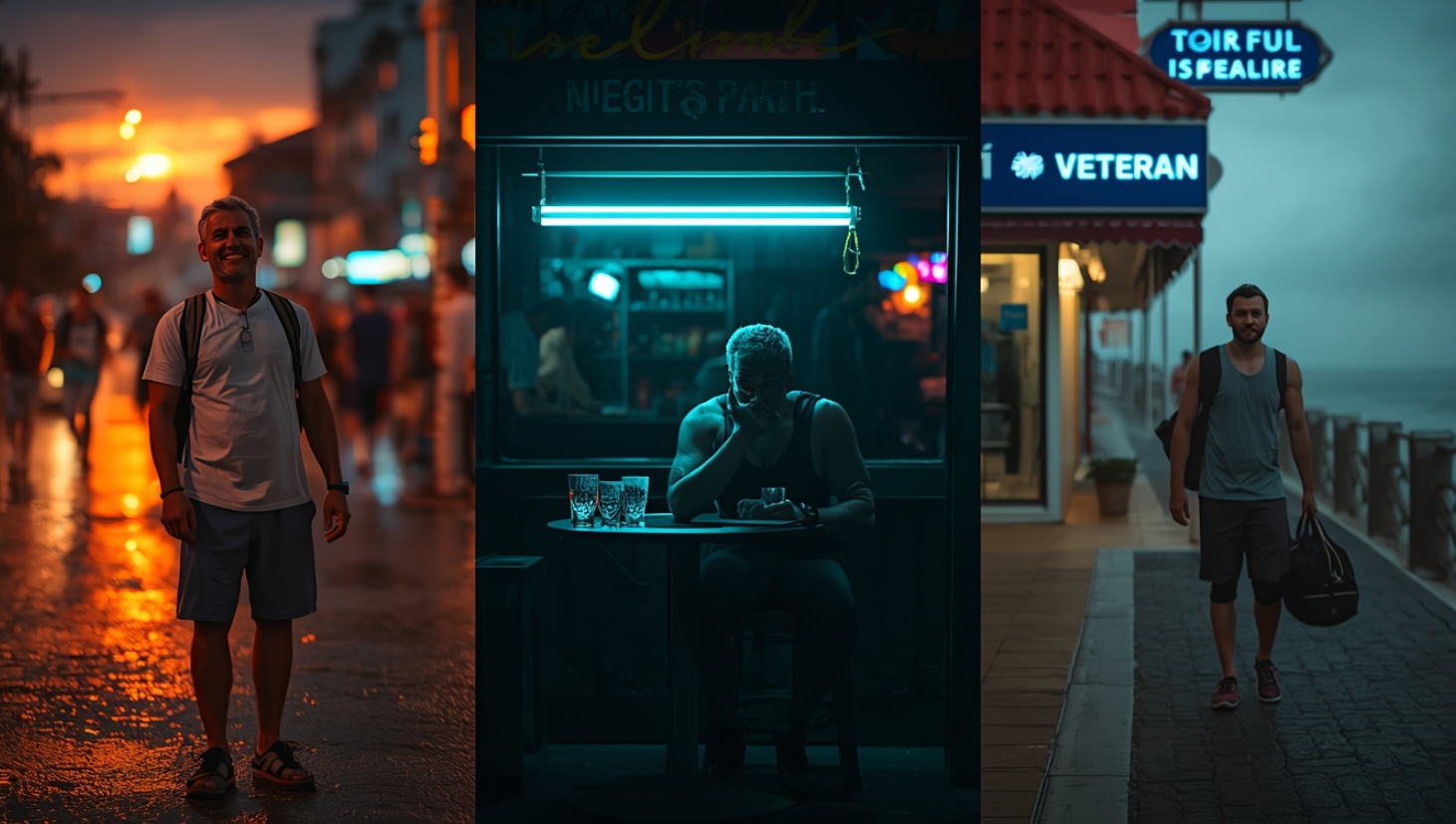
First-time visitors often describe the experience as genuinely life-changing, in ways that are hard to convey to people who haven’t been. For men who’ve spent years feeling overlooked, romantically, professionally, and socially, suddenly being the center of attention creates an almost euphoric sense of liberation. Many plan their return before they’ve even left.
Long-term expats tell a different story. After the wide-eyed wonder fades, what once felt magical tends to become mundane, and sometimes toxic. The pattern is consistent enough that you can map three distinct expat archetypes:
The Temporary Tourist arrives for two weeks, has a genuinely great time, and goes home with stories and a tan. He leaves before the illusion has time to crack. Of the three types, his experience is probably the healthiest, and there’s a reason this archetype has its own name.
The Hopeful Immigrant moved to Pattaya believing that paradise would fix something broken in himself. He came for cheap living, easy company, and a fresh start. By year two, he’s drinking heavily, posting cynical commentary in Facebook expat groups, and has neither Thai friends (because he never learned the language) nor deep expat friendships (because everyone else is also running from something). He’s more isolated now than he ever was at home.
The Integrated Veteran figured it out. He learned Thai, at least conversationally. He built a life with structure, a gym, Muay Thai, and hobbies that have nothing to do with bars. He has genuine Thai friendships that aren’t transactional. He understands that Pattaya is a place, not a solution, and that places don’t fix people. The difference between this man and the Hopeful Immigrant comes down to one word: purpose.
Pleasure vs. Meaning: The Psychological core of the Pattaya trap
At the heart of everything described above lies one of the most fundamental principles in human psychology: the difference between hedonic pleasure and eudaimonic meaning.
Pattaya delivers hedonic pleasure in extraordinary abundance. Excitement, novelty, ego validation, and instant gratification are available around every corner. And like sugar, they produce a real spike in how you feel. The problem is the crash that follows, and the way your brain increasingly demands more stimulus just to reach the same level.
What Pattaya cannot provide is the deeper, more durable well-being that comes from authentic relationships, personal growth, purposeful contribution, and genuine self-knowledge. These are the nutrients your psychological health actually runs on. Without them, no amount of hedonic pleasure fills the gap.
Psychiatrists who work with the expat community in Thailand have described this as “junk food for the soul” as it tastes good, it’s readily available, and it feels satisfying in the moment. But it doesn’t nourish you. After the initial high fades, you’re left emotionally malnourished, craving the next hit.
The most serious long-term cases involve men who become so neurologically conditioned to constant stimulation that they lose the capacity for ordinary intimacy altogether. Tolerance builds, exactly as it does with any addiction. Some report that after extended time in Pattaya, something as simple as holding hands with a genuine partner back home feels too quiet, too slow. They have accidentally rewired their brains in ways that make authentic relationship-building nearly impossible.
What Actually Works: How to experience Pattaya without falling into the trap
None of this means Pattaya is without genuine value, or that everyone who visits is headed for psychological ruin. It means going in with your eyes open, which is the only way to experience it without being caught off guard.
If you’re already there, or planning to go, here’s what the men who thrive actually do differently:
Learn even basic Thai. A handful of phrases changes the entire dynamic. You stop being just another foreigner and become a person making an effort. Conversations open up in ways that are genuinely surprising.
Find purpose outside the nightlife. Muay Thai training, hiking, cooking classes, golf, language study, volunteering, and anything with structure, progression, and a community around it. The men who do well in Pattaya long-term have hobbies and routines that have nothing to do with bars.
Build real expat friendships. They exist. Look for the people with actual hobbies, who aren’t drinking every night, who have built lives with depth. They’re quieter and harder to find than the bar crowd, but they’re there.
Set your limits before you arrive. Decide in advance how long you’ll stay and how much you’ll spend. Don’t let the environment make those decisions for you.
Don’t mistake performance for genuine affection. This sounds obvious, but it’s deeply counterintuitive in the moment, when everything in your emotional brain is telling you otherwise. Keep your head clear.
And most importantly, if you’re struggling with loneliness, depression, or lack of purpose before Thailand, take that seriously. Those issues will follow you on the plane, wait patiently at your hotel, and still be there when you go home. Pattaya is not a solution to those problems. In many cases, it accelerates them. If what you’re actually looking for is a genuine connection, it’s worth reading how dating in Thailand actually works before you arrive.
The bottom line
Pattaya is not evil. The men who go there aren’t broken, and the women who work there aren’t villains. But it is, as one long-time observer described it, a psychological minefield that catches thousands of unprepared travelers off guard every year.
The city offers unlimited freedom: freedom to do whatever you want, to meet someone new every night, to exist without judgment or responsibility. But freedom without connection is just another kind of prison.
The only real antidote to loneliness has always been authentic connection first with yourself, and then with others. That’s not something any bar can sell you, in Pattaya or anywhere else in the world.
Go in with your eyes open. Understand that the initial high is temporary and neurologically driven. Recognize that transactional relationships, however warm they feel in the moment, can’t substitute for genuine human connection. And if you find yourself surrounded by noise and people and laughter and still feeling hollow at 4 a.m. — know that what you’re feeling is real, it’s common, and the answer to it isn’t another bar.
Planning your first trip to Thailand? Explore more guides on Thailand nightlife and expat life throughout this blog.
