The Internet myth vs reality
Ah, Bangkok, the promised land where Western currency transforms you into royalty, where $1,000 stretches like mozzarella on a pizza, and where you can live like a king while working three hours a week from a beachside café. At least, that’s what the YouTube algorithm wants you to believe.
The “$1,000 Bangkok challenge” has become internet folklore, perpetuated by backpackers who spent two weeks in Khao San Road hostels, lifestyle influencers whose “minimal budget” includes sponsored stays, and blog posts from 2012 that haven’t been updated since the iPhone 5 was cutting-edge technology. Back then, 1,000 USD got you roughly 30,000 Thai Baht. Today? You’re looking at around 31,000-34,000 THB depending on whether the exchange rate gods are smiling. For euros, it’s, a bit more somewhere in the 35,000-37,000 THB range.
So lets get into it: zero sugarcoating, no affiliate links disguised as advice, and definitely no “I lived in Bangkok for $500 a month!” clickbait. We’re going full accountant mode, with a side of dark humor.
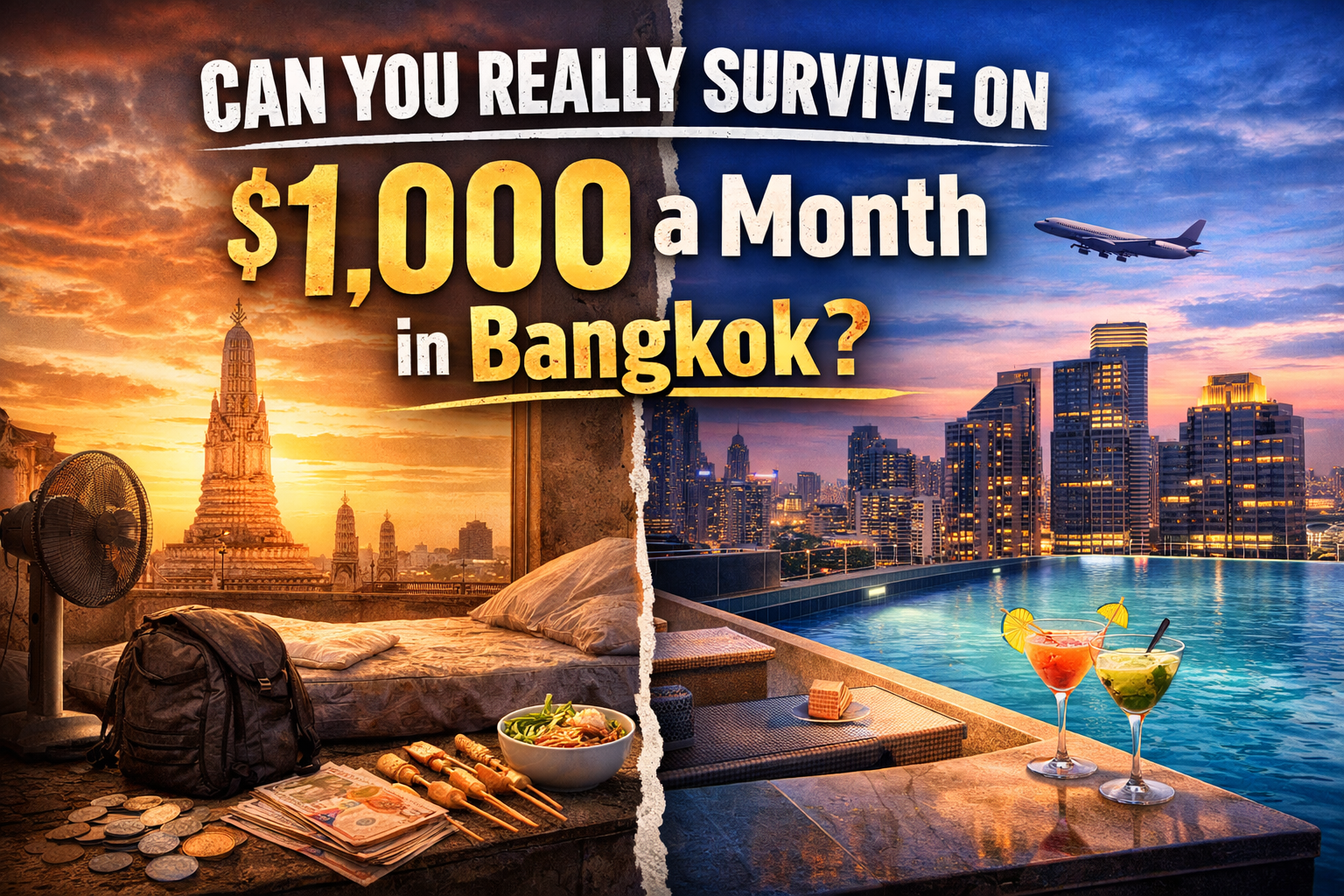
The bottom line upfront: Yes, you can survive on $1,000 per month in Bangkok. But not the way most people imagine. Think less “digital nomad at a rooftop bar” and more “contestant on a budget reality show where losing means eating instant noodles until your sodium levels file a complaint.”
What “Survive” actually means for you?
Before we dive into spreadsheets that’ll make you reconsider your life choices, let’s get philosophical for a moment. Surviving means you have shelter, food, and haven’t been deported. Living means you can occasionally go out, enjoy Bangkok’s incredible food scene beyond 7-Eleven sandwiches, and run the AC without calculating the cost per minute. Thriving means you have savings, health insurance, can handle emergencies, and don’t experience heart palpitations when unexpected expenses appear.
On $1,000 per month, you’re firmly in “surviving” territory. Are you single or supporting a family? Do you need regular medical care? Are you staying three months or three years? A 25 year old with no health issues can get away with things that would be absolutely catastrophic for a 45 year old with a dodgy knee. This budget is like a small t-shirt. Sure, you can technically wear it, but should you? And for how long before something rips?
The Hard Math: 1,000 USD/EUR in Thai Baht (Today)
Let’s talk cold, hard currency. It gets you somewhere between 31-36,000 THB. We’ll work with 35,000 THB as our baseline which might be a bit more than 1,000 USD but we will use it and that’s your monthly ammunition.
But here’s the fun part nobody mentions: exchange rates are about as stable as a three-legged bar stool. The baht can swing 5-10% in a matter of months. That carefully planned “$1,000 budget” might become a “30,000 THB reality” real quick. Then there’s inflation. Thailand isn’t the frozen in time budget paradise it was a decade ago. The street vendor who used to charge 35 baht for pad thai now charges 40-60 baht. Your 35,000 THB today doesn’t buy what it bought in 2019, let alone 2015.
Bare-Bones monthly budget breakdown
Alright, here’s where the magic happens. And by magic, I mean crushing mathematical reality.
You’re looking at a studio room in the outer suburbs for 6,000-10,000 THB. Think On Nut, Bearing, Bangna or even further out. Maybe an old pool, and gym equipment from 10 years ago, just one room with four walls and if you’re lucky, a tiny balcony. Yes you can get cheaper places mostly in upper floors of townhouses for lets say 3-5000 THB but it really is not comfortable at all. Central areas like Asok or Thong Lo? Forget it. Those studios start at 12,000-15,000 THB minimum. At this price point, you’re living 30+ minutes from anything interesting.
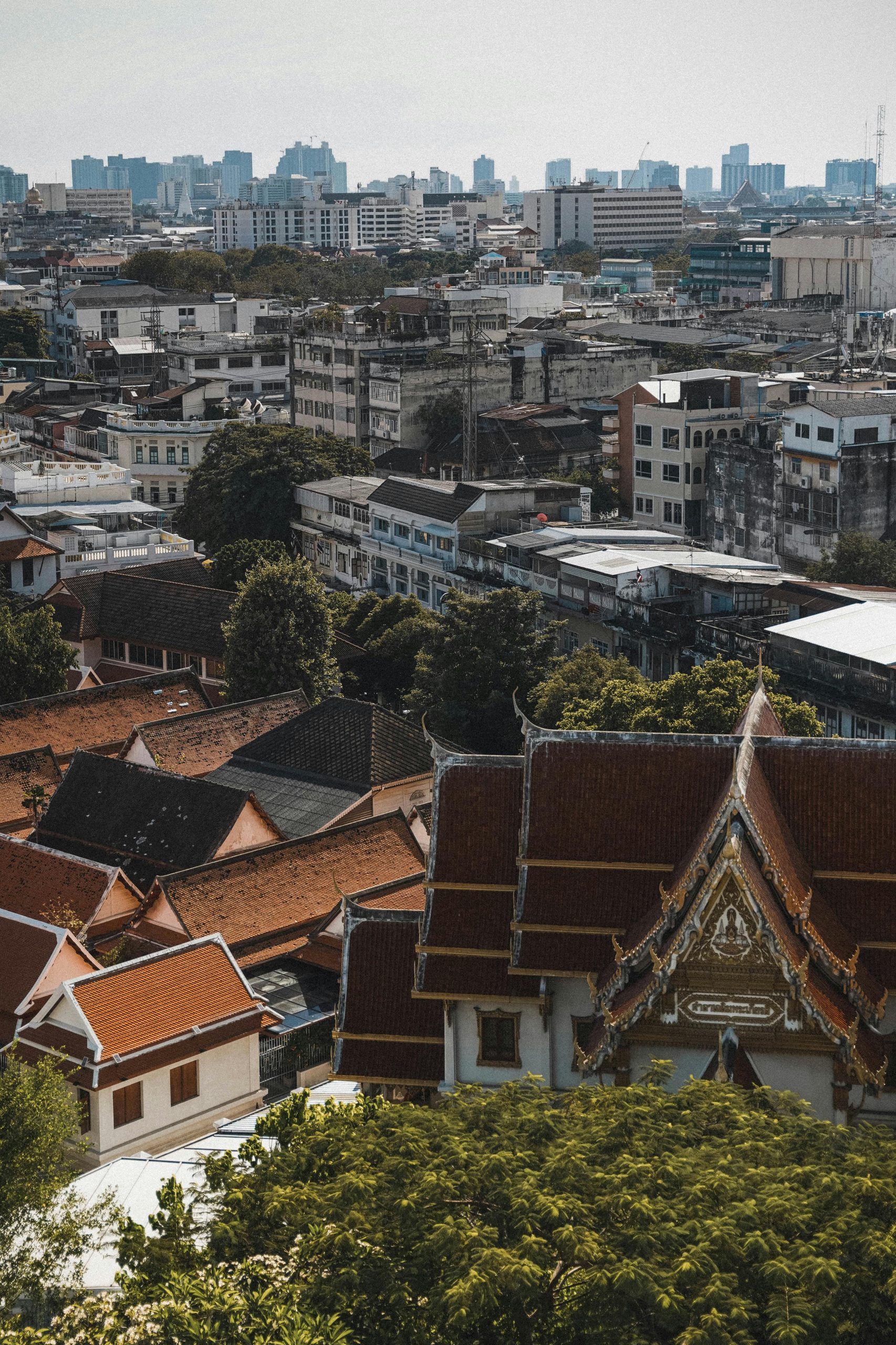
Utilities will run you 1,500-2,500 THB, and electricity is your mortal enemy. Bangkok is hot, like “you’ll sweat through your shirt just thinking about going outside” hot. Running AC all night costs 2,000+ THB easily, so you’ll ration it like it’s the apocalypse. AC for a few hours before bed, fan the rest of the time, and praying to whatever deity controls thermostats. You will tell yourself and everyone else how you don’t need AC but we all know the truth.
Food costs 8,000-12,000 THB if you’re eating street food and food courts for every meal. Rice with one topping runs 50-60 THB, noodle soup 50-70 THB. You’re eating Thai food exclusively because that burger costs 200+ THB and pizza is a luxury you literally cannot afford. Cooking at home might save money, but your shoebox studio has a hotplate that barely works.
Transport eats another 1,500-2,500 THB monthly. If you’re near BTS/MRT, that’s 1,000-1,500 THB for daily commutes. If not, you’re taking buses which are dirt cheap but slow or motorbike taxis that add up fast. Walking is free, and you’ll do a lot of it. Your calves will be magnificent.
Add in phone credit (300-500 THB), visa costs amortized monthly (500-1,500 THB because those border bounces and extensions aren’t free), and even those aren’t even possible in 2025 with the crackdowns so you will need to fork out a few hundred bucks for a DTV visa or go with an education visa. Healthcare at exactly zero baht because you’re uninsured and playing Russian Roulette with your health. A clinic visit for minor issues costs 500-1,000 THB. A hospital visit for anything serious? You’re bankrupt.
Total minimum spend: 18,800 – 31,000 THB
Remaining buffer: 4,000 – 16,200 THB
And that buffer is for literally everything else you might need: toiletries, haircuts, clothing replacement, entertainment, emergencies, or the soul crushing realization that you need new shoes and your current pair has holes. At this point, there is no buffer. There is only anxiety.
What you must give up at this budget
Let’s talk sacrifice. You’re living in the suburbs, so your friends visiting Bangkok will stay in Sukhumvit while you spend and hour on public transport to meet them. Your entire living space is smaller than some people’s closets and you can touch opposite walls simultaneously if you stretch. You become a monk of temperature tolerance, developing a weird relationship with your fan. You name it. It’s your only friend now.
Every meal is a budget calculation. Western food is a distant memory. That café latte? Absolutely not. You’re a 7-Eleven iced coffee person now. Your social life moves to free temples and public spaces because one beer in a bar costs 120-180 THB and that’s 2-3 meals. Dating in Bangkok is expensive, and coffee dates plus dinner easily hit 1,000+ THB. Those gorgeous islands and northern mountains? Not for you. You’re Bangkok bound, watching everyone else’s travel photos on social media.
But the biggest sacrifice is peace of mind. You can’t relax. Every expense is scrutinized. Every baht is precious. You develop anxiety around money that permeates everything. Fun becomes stressful because it costs money. Is this really how you want to live?
Scenarios: who can and cannot do this
The 22 year old backpacker might pull this off. Young, healthy, flexible, here for 3-6 months max. This is an adventure, not a lifestyle. The super minimalist who genuinely doesn’t care about comfort and actively enjoys the challenge could make it work. Someone with savings or family support back home, they’re “living on $1,000/month” but have an emergency fund. That’s cheating, but it works.
But anyone with health issues? Regular medications or chronic conditions mean you need insurance and a buffer. This budget has neither. For single parents the numbers don’t remotely work. Older adults face multiplied health risks and the physical toll of budget living hits harder. Digital nomads with irregular income need larger buffers because one slow month and you’re screwed. This budget is inherently unstable. One emergency destroys it. You can’t build a life on constantly crumbling ground.
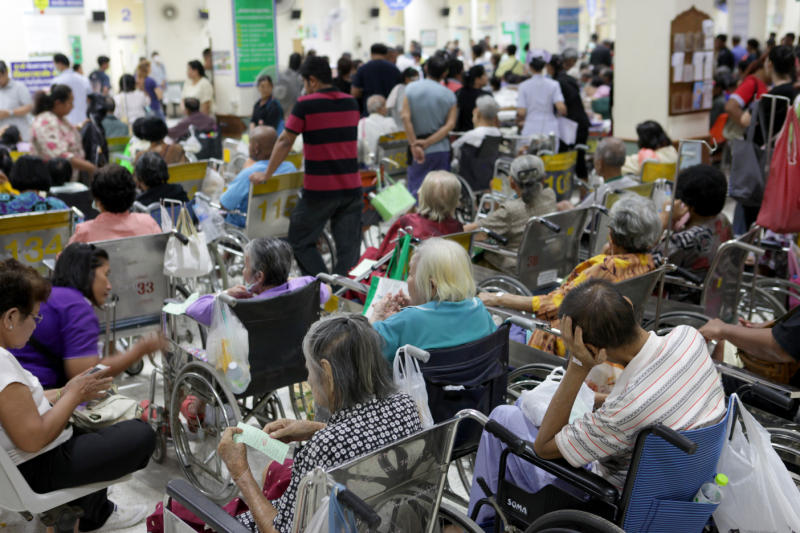
Thailand has some of the best hospitals in the world but you have to have money to pay for it. Other option are the overcrowded goverment hospitals which will be a lot cheaper but also far from those best hospitals i mentioned.
Hidden costs that kill the budget
Here’s where your carefully planned budget goes to die. Border bounces if even an option cost 2,000-5,000 THB every few months. One hospital visit without insurance can run 10,000-50,000+ THB. Moving requires deposits which is usually 2 months rent upfront, which is hilarious when your monthly buffer is 4,000 THB. When your phone screen cracks or laptop dies, you’ll be researching “how to fix phone screen with toothpaste” at 2 AM.
Family emergency back home? Return plane tickets cost 20,000-50,000 THB. April-May electricity bills can double during hot season and your 1,500 THB estimate becomes 3,000 THB. And after a few months, you’ll crack. You’ll desperately need a nice meal, a comfortable space, a break from the grind. That 2,000 THB splurge nukes your buffer for the month.
Psychological cost of living on the edge
Every purchase becomes a calculation. You’re solving math problems instead of living your life. You start declining invitations because they cost money, becoming isolated and lonely. Bangkok is an incredible city full of life, and you’re watching it through a window you can’t afford to open. Every day is one disaster away from catastrophe. The anxiety is constant, low-grade, exhausting. Should you take the bus or BTS? Eat now or wait? Buy the 15 THB water or drink from the tap and risk it? Every tiny decision carries weight and leads to decision fatigue. Depression and anxiety thrive in financial stress. You’re in a foreign country, isolated, counting coins, unable to enjoy life. Living on the edge isn’t adventurous, it’s corrosive.
So… Is It Worth It?
Here’s the honest answer: It depends on why you’re doing it and for how long.
It might be worth it if you’re young and treating this as a temporary adventure with a specific goal like learning Thai, finishing a project, building toward something better. It’s definitely not worth it if you’re escaping problems that will follow you, have no backup plan, or are sacrificing your health doing it indefinitely with no path to improvement. The sustainability timeline is brutal. Three to six months is doable, you’re a traveler having an experience. Six to twelve months gets rough as novelty wears off. Twelve to twenty-four months becomes damaging to your health, relationships, and mental state. Beyond twenty-four months? Why are you doing this to yourself?
This isn’t a lifestyle. It’s an endurance test with unclear benefits.
What is a smarter minimum budget for Bangkok?
Want to actually live in Bangkok, not just survive? Aim for $1,500-1,700 USD or €1,400-1,600 EUR, which translates to roughly 50,000-60,000 THB monthly.
At this level, you can afford decent housing for 12,000-15,000 THB in a better location with a pool, gym, and actual kitchen. You’re closer to civilization with a reasonable commute. You can run the AC without daily existential dread and sleep comfortably. Food stops being a source of stress. You eat Thai food most days, but occasional Western meals, coffee shop visits, and restaurants with friends become possible.
You’ll have an entertainment buffer of 3,000-5,000 THB for movies, bars, events, and weekend trips. To experience the famous Bangkok night life you will have to borrow money from your family back home. You can actually enjoy Bangkok and you know, the reason you moved here. You can build an emergency fund, saving 5,000-8,000 THB monthly for visa, medical needs, or actual emergencies. Basic health insurance costs around 3,000-4,000 THB and means a hospital visit doesn’t destroy your life.
At 50,000-60,000 THB monthly, you transition from surviving to actually living. You can breathe, enjoy yourself, and build something sustainable. Is it still budget living? Absolutely. But it’s budget living with dignity, health, and occasional joy.
Final Verdict: can you really do it?
Yes, technically. You absolutely can survive on $1,000/€1,000 per month in Bangkok. People do it. Numbers can be made to work. It’s mathematically possible.
No, not comfortably. You’ll sacrifice location, space, food variety, social life, peace of mind, and probably your mental health. Every day will be a budget negotiation. Every expense will sting.
It depends entirely on your age and health, your timeline and goals, your support system and backup plans, your tolerance for discomfort, your ability to handle financial stress, and whether you have literally any other option.
The truth most blog posts and “Influencers” won’t tell you: This budget worked better in 2015. It worked even better in 2010. Today, in 2025, with inflation, increased costs, and higher expectations, it’s a grind that extracts more than it gives.
If you’re young, adventurous, and time-limited then go for it. You’ll have stories. Some might even be good ones. But if you’re considering this as a long term plan, an escape route, or because you think it’ll solve your problems then reconsider. The problems will follow you, and now you’ll have less money to deal with them. Bangkok is an incredible city. It deserves to be experienced with at least some degree of financial stability and mental peace. Struggling to afford dinner every night isn’t experiencing Bangkok, it’s experiencing poverty tourism with a side of pad thai.
So can you survive on $1,000/month in Bangkok? Sure. But you probably shouldn’t. And you definitely won’t want to for long. You could probably live alright in the north, in a smaller city or village but this was just about Bangkok.
Welcome to Bangkok. Please bring more money.


Pingback: Thailand Visa Guide: Everything Bangkok visitors need to know
Pingback: Why Are Expats Leaving Thailand? - Bangkok Travel, Hotels, Living & Dating Guide | VisitBangkok.org