If you are planning a trip to Thailand in September 2026 or later, there are a few important changes worth knowing before you board your flight.
The biggest one is Thailand’s new 30-day visa exemption, which replaces the 60-day visa-free stay that many travelers have been enjoying since 2024. There are also changes and developments involving tourist visas, border runs, the Thailand Digital Arrival Card, immigration autogates and transportation from Suvarnabhumi Airport.
For most normal tourists, entering Thailand is still straightforward. But if you are planning to stay for several weeks, return to Thailand frequently or spend several months in the country, the details become much more important.
Here is what you need to know before traveling to Thailand.
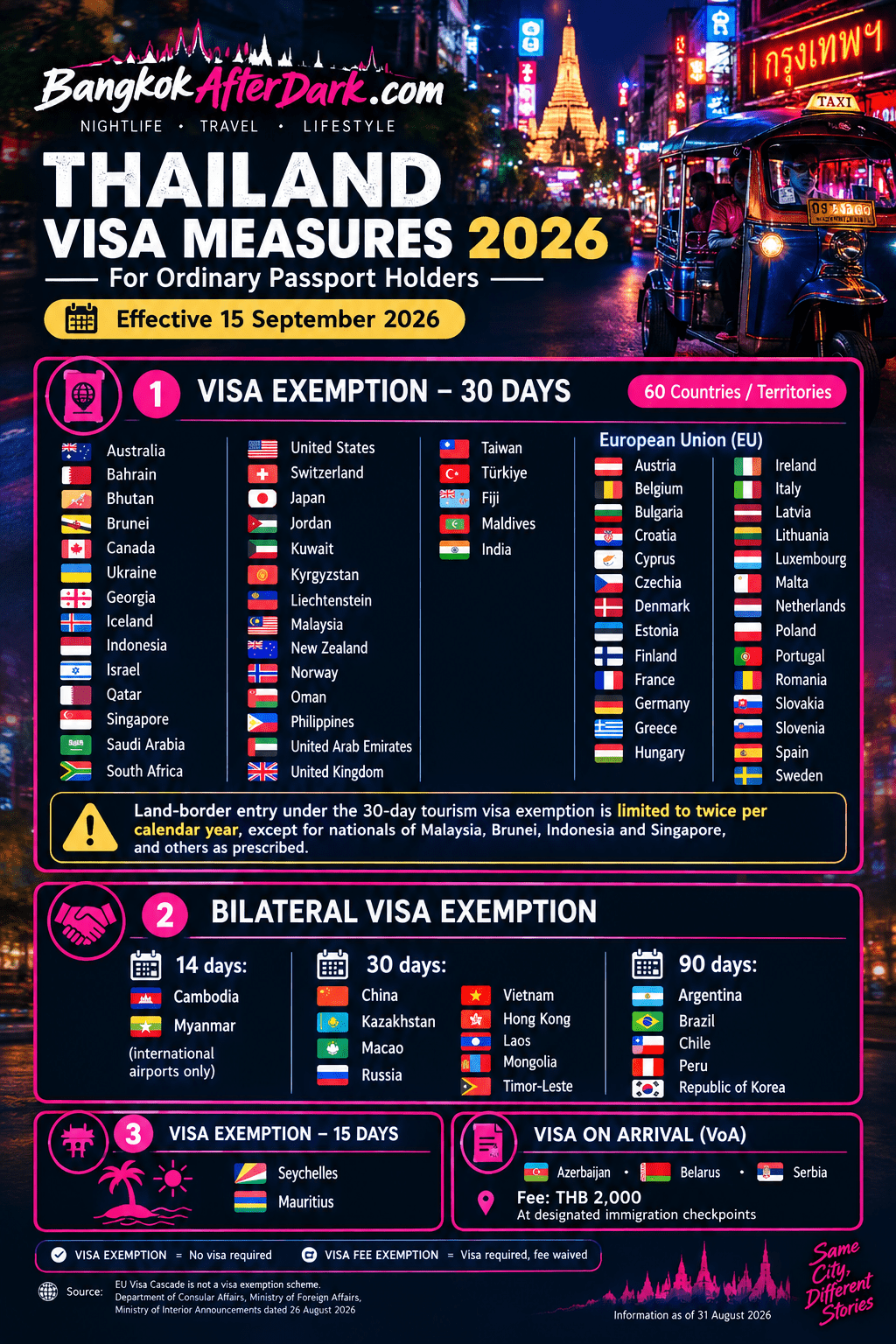
Thailand Visa-Free Stay Drops From 60 Days to 30 Days
The biggest change takes effect at midnight Thai time on September 15, 2026.
Thailand published the new visa policy in the Royal Gazette on August 31, 2026. The change ends the special 60-day visa exemption that had been in place since July 2024.
Under the new rules, travelers from eligible countries will generally receive 30 days visa-free when entering Thailand, instead of 60 days.
There is also a significant reduction in the number of countries covered by the main visa exemption list, from 93 countries to 60. Some other important tourism markets are covered through separate bilateral agreements.
The timing is particularly important if you happen to be traveling around September 15.
Arrivals before midnight on September 15 remain under the previous rules, while arrivals after the change takes effect are subject to the new 30-day period.
For anyone planning a typical two-week or three-week holiday in Bangkok, Phuket, Pattaya, Chiang Mai or elsewhere in Thailand, this probably changes very little.
For longer stays, however, you now need to plan ahead.
Can You Extend a 30-Day Thailand Visa Exemption?
Yes.
Travelers entering Thailand under the visa exemption can generally apply for a 30-day extension at a Thai immigration office.
The extension costs 1,900 baht, giving you a potential total stay of up to 60 days on that entry.
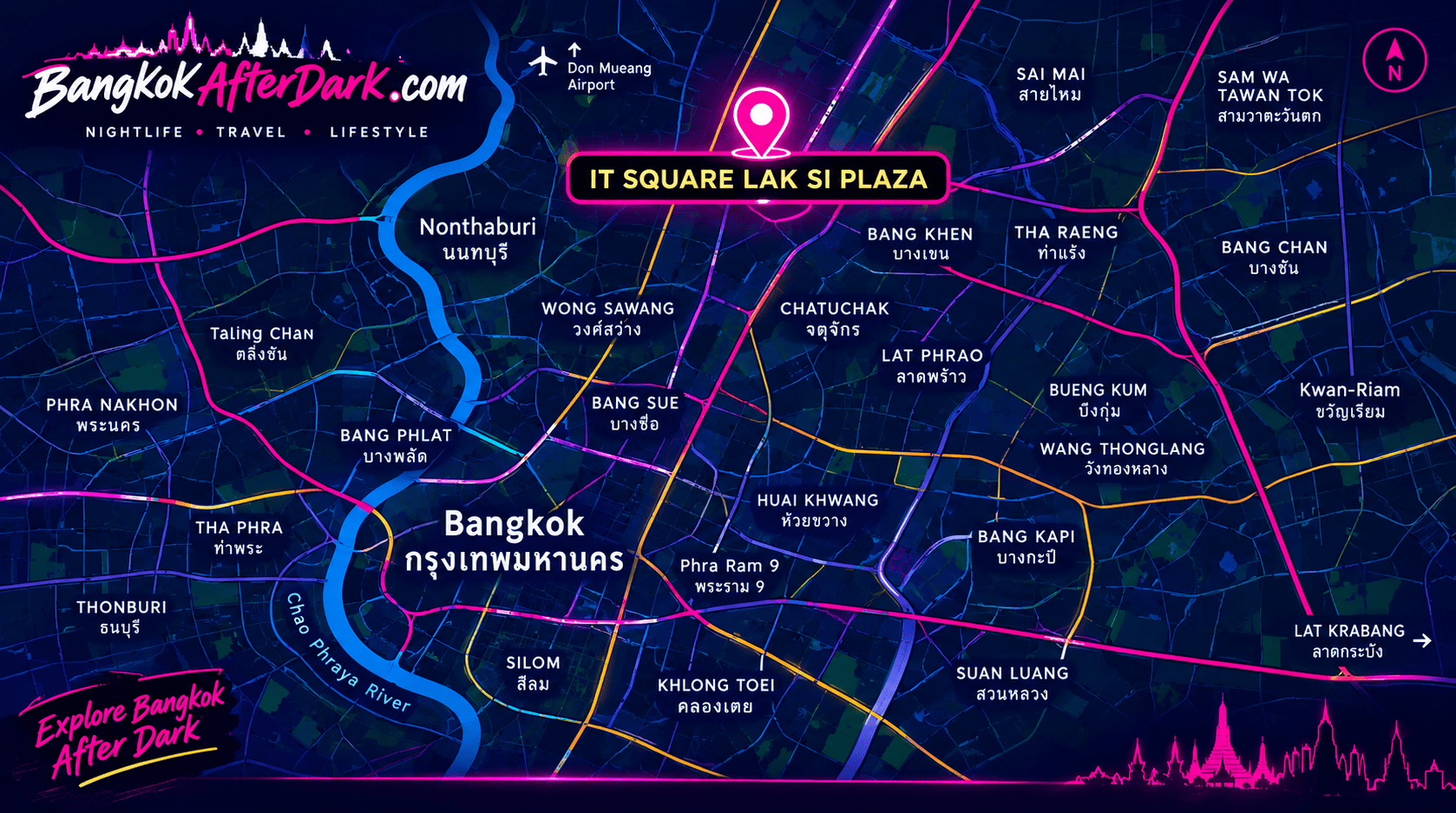
In Bangkok, visa-exempt extensions are handled at the immigration office at IT Square Laksi, on the third floor.
You will generally need:
- Your passport
- Passport photos
- Copies of your passport information page
- A copy of your entry stamp
- The completed immigration form
- The 1,900 baht extension fee
Immigration offices outside Bangkok are available throughout Thailand, although procedures can vary slightly between offices.
It is also worth remembering that an immigration extension is not exactly a quick five-minute errand. Depending on the office and how busy it is, you can lose a substantial part of the day.
If you are planning to extend your stay, going during the middle of the week and arriving early is generally a better strategy than turning up late on a Friday.

Staying Longer Than 60 Days? Consider a Tourist Visa
If you already know that you want to spend more than 30 days in Thailand, getting a tourist visa before your trip may make more sense.
A single-entry tourist visa can provide a 60-day stay when you enter Thailand.
You can generally extend it for another 30 days at a Thai immigration office for 1,900 baht.
That gives you a potential 90-day stay in Thailand.
You apply online through Thailand’s official e-Visa system, and the Thai embassy or consular authority for your location ultimately processes the application.
This means processing times and visa fees can vary depending on where you apply.
If you are traveling on a tourist visa, don’t leave the visa sitting somewhere in your email and assume everything will automatically work at the airport. It is sensible to print the visa and present it to the immigration officer when you enter Thailand.
And once you receive your entry stamp, check it.
A simple mistake on an immigration stamp can become considerably more annoying to fix once you have left the airport.
What About the Multiple-Entry Tourist Visa?
Thailand also offers a Multiple Entry Tourist Visa (METV) for travelers who expect to visit the country repeatedly.
The visa has a six-month validity period, but there is an important detail that catches people out.
The six-month validity period begins when the visa is issued, not when you first enter Thailand.
So applying too early can reduce the useful period of your visa.
Each entry normally provides up to 60 days in Thailand, with the possibility of a 30-day extension.
That sounds extremely attractive on paper, but there are some limitations.
You may need to leave Thailand and re-enter during the visa’s validity period, and extensions still involve visiting immigration and paying the 1,900 baht fee.
For someone making multiple genuine trips to Thailand, the METV can make sense. For a single long holiday, however, a single-entry tourist visa may be simpler.
Thailand’s Destination Thailand Visa (DTV)
For remote workers, digital nomads and people who want to spend considerably more time in Thailand, the Destination Thailand Visa (DTV) is another option.
The DTV is a five-year multiple-entry visa designed for eligible long-stay visitors.
The application requirements are considerably more demanding than simply arriving as a tourist.
The application can require financial evidence, including proof of at least 500,000 baht in funds, along with other supporting documentation.
Applicants may also qualify through approved activities such as certain cultural or “soft power” programs, including Muay Thai or cooking courses, depending on the specific eligibility route.
The DTV is therefore much more suitable for someone who genuinely wants a longer-term connection with Thailand rather than someone coming for a three-week holiday.
Are Border Runs Still a Good Idea in Thailand?
This is where things get more complicated for long-term visitors.
For years, some foreigners effectively lived in Thailand by repeatedly leaving the country and returning on visa exemptions or short-term visas.
The rules and enforcement environment have become considerably less friendly to this approach.
Thai immigration can look at a traveler’s entry and exit history, and repeated visa-exempt entries that appear to indicate someone is effectively living in Thailand without the appropriate long-term visa can attract additional scrutiny.
There is also a specific restriction concerning visa-exempt entries by land border, with a maximum of two such entries per year under the general rule, although certain nationalities have exceptions.
There is no equivalent official numerical cap for visa-exempt air arrivals, but that does not mean you can simply fly out of Thailand every few weeks indefinitely without questions being asked.
In other words, don’t confuse “there is no official air-entry limit” with “Thailand doesn’t care how often I enter.”
If your travel pattern looks like you are actually living in Thailand, immigration officers can take that into account.
For regular tourists, this is unlikely to be an issue.
For someone spending most of the year in Thailand while relying entirely on visa exemptions, it is a different story.
Don’t Forget the Thailand Digital Arrival Card (TDAC)
Whether you enter Thailand using a visa or visa-free, you need to complete the Thailand Digital Arrival Card (TDAC) before arrival.
The TDAC must be completed within the required three-day period before entering Thailand.
One important point: the TDAC is not a visa.
It is an arrival card and completing it does not guarantee that you will be admitted to Thailand.
The TDAC is free.
You can complete it through the official Thai government system or the official application mentioned by Thai immigration.
Be particularly careful when searching for the TDAC online.
There are third-party websites that look official and charge travelers for something that is available without a submission fee. Some even appear prominently in search results.
There is no reason to pay a random website to complete your TDAC.
Use the official Thai government system.
What Documents Should You Have When Entering Thailand?
Even if you are traveling to Thailand as a normal tourist, it is worth having your basic documentation in order.
Your passport should have at least six months of validity remaining when you enter Thailand.
It should also be in good condition.
Damaged passports, unofficial markings or unusual stamps can potentially create problems at immigration. The definition of what constitutes a damaged passport is ultimately subject to the immigration authority assessing it.
You should also be prepared to show evidence of an onward or return flight.
If you are entering Thailand for 30 days and have a return flight within those 30 days, that is relatively straightforward.
If you plan to extend your stay, it is still worth having a sensible explanation and documentation supporting your travel plans.
It can also be useful to have:
- Proof of accommodation
- A hotel booking
- A general itinerary
- Proof of sufficient funds
- An onward or return ticket
Thailand’s stated financial requirement can be 20,000 baht per person or 40,000 baht per family, and travelers may be asked to demonstrate that they have sufficient funds.
That does not mean every tourist will be asked to empty their wallet onto the immigration counter.
Most won’t.
Don’t Panic About Thai Immigration
There is a lot of information circulating online about Thailand’s immigration rules, and some of it can make entering the country sound considerably more frightening than it actually is. If you are a normal tourist visiting Thailand for a holiday, you are unlikely to encounter serious problems simply because the visa exemption has changed from 60 days to 30.
First-time visitors, occasional visitors and people who come to Thailand once or twice a year generally have little reason to worry. Thailand’s major international airports process enormous numbers of passengers, and only a small proportion are subjected to additional questioning or screening.
The best approach is simple: Have the correct documents, know how long you are allowed to stay and answer immigration officers honestly and politely.
What Happens at Thai Immigration?
When you arrive at the immigration counter, you will normally present your passport and boarding pass. If you have a visa, make sure the officer sees it. You will have your photograph taken and your fingerprints recorded as part of the biometric immigration process.
If the officer asks questions, answer them clearly. And before walking away from the counter, check your entry stamp or entry record and make sure the permitted stay is what you expected.
It is much easier to deal with an incorrect stamp immediately than discover the problem several weeks later.
Thailand Expands Immigration Auto-gates
There is also some good news for international travelers.
Thailand is preparing to expand its automated immigration auto gate system to more nationalities.
The planned expansion is expected to cover 33 nationalities, although the final official list and implementation date had not yet been announced at the time of the information covered here.
For eligible visa-exempt travelers, the autogates should make the arrival process significantly faster. Instead of joining a traditional immigration queue, eligible passengers will be able to scan their passport and complete biometric checks at an automated gate. The system uses facial recognition and fingerprints as part of the immigration process.
There is another interesting difference: travelers using the autogates will not necessarily receive a traditional passport stamp. Instead, they receive a receipt showing their permitted period of stay. If you really want a physical passport stamp, you can still use a staffed immigration counter.
Your First Entry May Still Require a Human Officer
There is an important catch.
The auto gate system needs biometric information to already be in the immigration system.
So even if your nationality is eligible, your first entry into Thailand may still require you to use a staffed immigration counter.
Once your biometric information is recorded, subsequent eligible entries can potentially be much faster.
Travelers entering Thailand on a visa also still need to use a staffed immigration counter because the officer needs to process the relevant visa and entry conditions.
That includes tourist visas and various long-stay visa categories.
Everyone Can Use Autogates When Leaving Thailand
There is a slightly different situation when departing Thailand.
Travelers of any nationality can use the departure autogates as long as they have an eligible e-passport.
However, automated gates do not mean immigration checks have disappeared.
If your travel history raises questions, you can still be referred to an immigration officer for additional screening.
Suvarnabhumi Airport Rail Link Disruptions
If you are flying into Bangkok soon, there is one more thing to keep in mind.
The Airport Rail Link between Suvarnabhumi Airport and central Bangkok has experienced disruptions and delays due to maintenance issues and reduced train availability.
Additional buses and coordination with Bangkok’s MRT and BTS systems have been used to help manage passenger demand, particularly during busy periods.
If you normally rely on the Airport Rail Link to get into Bangkok, give yourself some extra time, particularly during rush hour.
And have a backup plan.
Grab and Bolt are obvious alternatives, while official airport taxis and airport buses are also available.
For travelers staying around Sukhumvit, Asoke, Rama 9 or other central Bangkok areas, a ride-hailing service may be considerably more convenient if the rail system is experiencing delays.
What Thailand Travelers Need to Know in September 2026
The short version is this:
Thailand is still easy to visit, but the rules have changed.
For most tourists, the biggest change is the reduction of the visa exemption from 60 days to 30 days from September 15, 2026.
If you need more time, you can potentially extend that stay by another 30 days.
If you already know that you want to stay longer, a tourist visa may be a better option.
For frequent visitors or people planning to spend a large part of the year in Thailand, relying on repeated visa-exempt entries is becoming increasingly risky. A proper long-term visa such as the DTV may be more appropriate depending on your circumstances.
Before flying, make sure you have:
- A passport valid for at least six months
- Your TDAC completed within the required period
- Proof of onward or return travel
- Accommodation information
- Evidence of sufficient funds if requested
- Your visa documentation, if applicable
- A backup transportation plan if arriving at Suvarnabhumi during rush hour
For a normal holidaymaker, none of this should be particularly stressful.
Thailand remains Thailand. You just need to know the rules before you land.
And if you’re heading straight into Bangkok after arriving at Suvarnabhumi, check the Airport Rail Link situation before you leave the airport. Your first Bangkok adventure doesn’t need to begin with an unexpected platform wait.
Planning a trip to Bangkok? Check our Bangkok nightlife guides, neighborhood guides and practical Thailand travel information before you arrive.