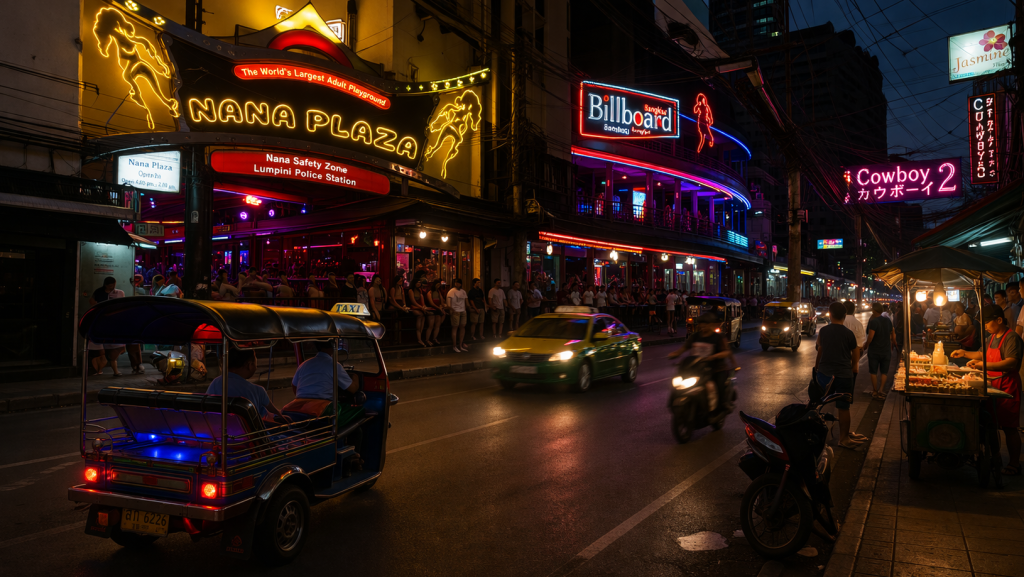
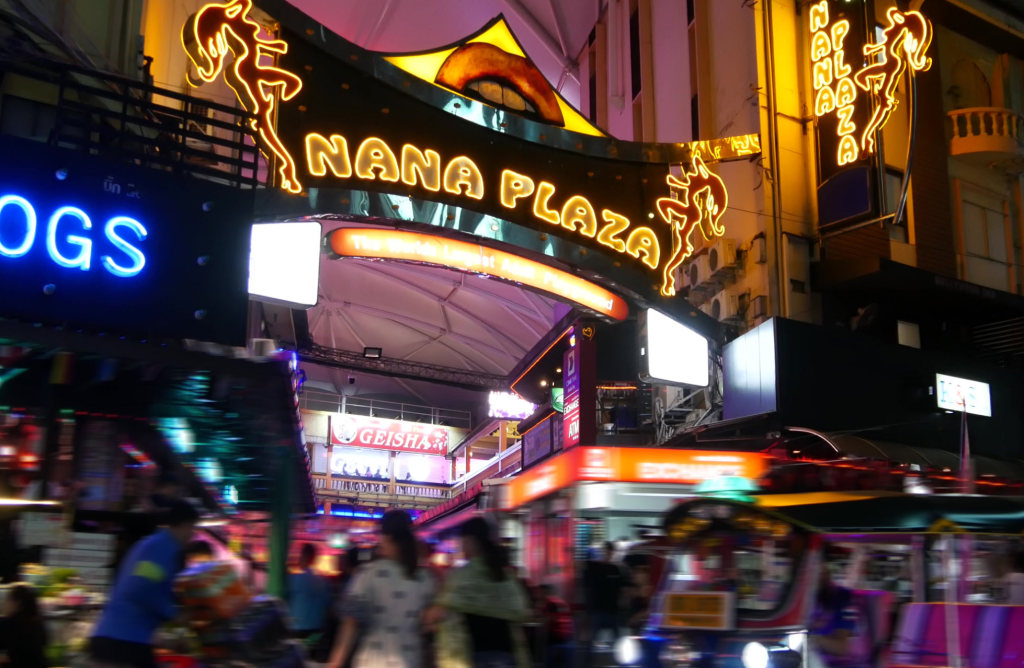
Spend one evening at Nana Plaza or Soi Cowboy, and you will notice something that, once you see it, you cannot unsee. Look around the bar. Look at the stools, the booths, the guys nursing beers by the stage. Western faces. Japanese faces. The occasional Korean visitor. Long-term expats who have been in Bangkok so long that they have a dedicated stool with their name on it, spiritually if not literally.
Thai men? Almost nowhere.
For a scene that operates in the heart of a Thai city, employs Thai women, plays Thai pop music between the sets, and is theoretically open to anyone with the price of a beer, the absence of Thai male customers is striking. It is one of those things that first-timers rarely think to ask about, but veterans of the Bangkok nightlife scene find genuinely interesting once they start pulling the thread.
The answer is not simple. It is actually four or five different answers stacked on top of each other, and each one reveals something real about Thai culture, social structure, and the particular economics of the gogo bar business model.
Reason One: Price
Start with the most obvious factor, because it is real even if it is not the whole story.
A night out at a gogo bar in Bangkok – even a modest one is priced for a foreign income. Beer runs 160 to 200 THB. Lady drinks are 220 to 260 THB. A bar fine at a mid-tier Nana Plaza bar starts at around 600 to 700 THB and goes up from there. For the full breakdown of what everything costs, our real cost of company in Thailand guide lays it all out.
For a Western visitor earning in dollars or euros, this is cheap. Genuinely, almost embarrassingly cheap compared to what a similar evening would cost in London, Amsterdam or Sydney. That price gap is part of what makes Bangkok’s nightlife economy function – it keeps the venues full of free-spending foreigners who find the whole experience remarkably affordable.
For an average Thai man earning a local salary, the calculation looks entirely different. The median monthly wage in Bangkok sits somewhere around 15,000 to 18,000 THB for an ordinary worker. A single night at a gogo bar – two or three beers, a lady drink or two, a bar fine could easily run 2,000 to 3,000 THB. That is a significant slice of a week’s income for an experience that is priced as a night out for someone earning in a hard currency.
The same bar. The same beer. Two completely different financial experiences depending on what currency you earn in.
This alone would explain a significant gap in Thai male attendance. But it is only the beginning.
Reason Two: Thai Men have their own scene – and it looks nothing like this
The assumption underneath the question is that gogo bars represent the default format for adult entertainment. For Farangs, they largely do – they are the most visible, the most accessible, and the most tourist-friendly option in Bangkok, as any guide to Bangkok’s red light districts will confirm. But Thai men who want to spend money on female company are not choosing between a gogo bar and staying home. They have a completely parallel industry available to them, one that most foreign visitors never see or even hear about.
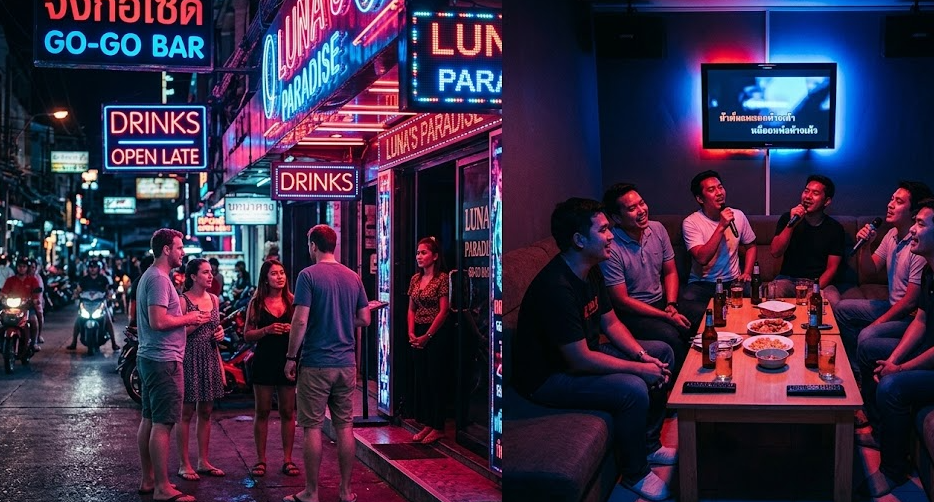
Karaoke bars – real ones, not the tourist-facing versions are the dominant format for Thai male adult entertainment. The Ratchadaphisek area runs dozens of them, most operating on a private room model where a group of men books a room, orders bottles, and is joined by hostesses for the duration. The whole experience is more private, more social in a group-of-friends sense, and structured completely differently from the open-floor gogo bar format.
Then there are the soapy massage parlors concentrated in Ratchada and a few other areas, which cater heavily to Thai, Thai-Chinese, and Japanese clientele. For anyone curious about how that side of Bangkok operates, our soapy massage prices guide covers it in full. The short version is that Thai men who want that kind of evening have well-established, culturally comfortable options that do not involve sitting in a room full of foreigners watching a stage show calibrated for someone else’s entertainment.
The gogo bar format with the stage, dancers, open seating, mixed international crowd is essentially a product designed for and by foreign tastes. Thai men were never really the target market, and the industry evolved accordingly.
Reason Three: The cultural discomfort of being the only one
Imagine walking into a bar where you are immediately and obviously the only person of your nationality, your cultural background, and your income bracket. Where the whole operation has been tuned for someone else’s comfort and preferences. Where the girls on stage have been coached to engage with a specific type of customer and you do not match the profile.
That is the experience of a Thai man walking into a Nana Plaza gogo bar. The environment signals, at every level, that this space was built for Farangs. The prices are Farang prices. The dynamic is a Farang dynamic. Even the way the girls interact with customers, the particular performance of availability and warmth that works on a foreign visitor seeing this world for the first time, is calibrated for someone who finds the whole thing exotic and slightly unreal.
A Thai man has no layer of exotic novelty insulating him from the transaction. He understands the Thai side of the conversation with a clarity that a foreign visitor simply does not have. For many Thai men, that clarity makes the whole experience feel less like entertainment and more like watching the engine room of a machine they would rather not think about too hard.
Reason Four: Face
Thailand runs on face in a way that is difficult to fully appreciate until you have spent real time in the country. The concept of kreeng jai, the instinct to avoid causing discomfort or embarrassment and the parallel concern with one’s own social standing shape behavior in ways that are often invisible to outsiders.
Walking into a gogo bar as a Thai man, sitting among foreigners, being served by Thai women performing a role that carries specific social connotations, all of this involves navigating a face calculation that a Farang customer simply does not have to make. The industry itself operates in a legal gray zone that most visitors never think about. If you want to understand how that works, our piece on whether prostitution is legal in Thailand covers the full picture, but for a Thai man embedded in Thai society, the social exposure is far more real than any legal one. The foreign visitor is insulated by his outsider status. He is not embedded in a Thai social network where someone might see him, where reputation travels, where family connections and workplace relationships are all in play.
A Thai man from Bangkok is not an outsider. He is embedded. The woman behind the bar might be someone’s cousin. The Mamasan might know his family. The possibility that his presence in a gogo bar could filter back through his social network is a real consideration that most foreign visitors have no equivalent of whatsoever.
This matters more than it might sound. In a culture where what people think of you has genuine practical consequences for your career, your family relationships, and your standing in the community. The idea of being spotted doing something that could be misread or gossiped about is a real deterrent. The Farang at the bar has no such problem. Nobody back home is going to hear about it. His Bangkok evenings exist in a consequence-free bubble that Thai men simply do not have access to.
Reason Five: The staff dynamic
There is a more operational reason that Mamasans in the know will mention if you ask them directly.
Some of the women working Bangkok’s gogo bars have Thai partners on the outside. Boyfriends, ex-husbands, men who have made a functional peace with the reality of the job while retaining a complicated emotional relationship with it. This is not universal, and most girls are single or in arrangements that work on their own terms but it is common enough that experienced bar managers are aware of it as a background variable.
A Thai male customer who happens to walk in carrying some prior connection to a member of staff, even an indirect one, even something as loose as a shared hometown or a mutual acquaintance, introduces a social complexity that a Farang customer structurally cannot. The foreign visitor is a clean slate. He has no pre-existing relationships with anyone in the building, no cultural overlap that might surface unexpectedly mid-conversation.
From the Mamasan’s perspective, a Farang customer is operationally predictable. He sits down, he orders, he interacts with the girls in the way the room is designed for, and eventually he pays and leaves. The probability that his presence introduces unexpected social dynamics into the workplace is low.
That predictability has value. It is part of why the gogo bar experience at places like Nana Plaza feels consistent in a way that other forms of Bangkok nightlife do not, and part of why, consciously or not, the whole industry has evolved toward serving the clientele that generates the least friction along with the most revenue.
What happens when a Thai man walks in
It is not unheard of. Thai men occasionally walk into Nana Plaza or Soi Cowboy – younger guys sometimes, often with a foreign friend who has brought them along, occasionally alone out of curiosity. Nobody is turned away. The beers are served the same as they would be for anyone else.
But the dynamic shifts in a way that is hard to describe without having seen it. The girls are less sure how to read the interaction. The price point lands differently on both sides. The whole calibration of the room, built over decades around a specific type of customer, runs slightly off when someone arrives who does not match the expected profile.
It usually confirms, for the Thai man in question, why he had not bothered before.
Two cities inside one city
Bangkok’s adult entertainment scene is really two separate industries operating in the same city, serving different clienteles, and rarely intersecting. The tourist-facing world with the gogo bars, freelancers working Soi 4 outside Nana, the neon-lit strips of Soi Cowboy and Patpong is built around foreign visitors and the economics of foreign income. The Thai-facing world with the karaoke rooms, soapy parlors, and private hostess venues runs on different pricing, different social codes, and different geography.
Understanding that these are parallel systems rather than one unified scene explains a lot about Bangkok nightlife that otherwise seems puzzling. The prices are not high because the bars are greedy. The environment is not designed to be exclusionary. Both are simply the result of an industry that evolved to serve the people who actually showed up and kept coming back.
Thai men figured out a long time ago that the gogo bar format was not built for them. They built their own thing instead. Both industries are doing fine in 2026, in their separate lanes, mostly invisible to each other.
The Farang nursing his Chang at Billboard and the Thai businessman in a private Ratchada karaoke room are having completely different evenings in the same city, spending roughly equivalent proportions of their respective incomes, and almost certainly never crossing paths.
Bangkok contains multitudes. The gogo bar is just one of them and it was always going to end up looking exactly the way it does.
New to Bangkok’s nightlife scene? Our Nana Plaza guide is the best place to start, and our Bangkok nightlife overview gives you the honest big picture before your first night out. For the full breakdown on how the economics work — bar fines, lady drinks, what things actually cost — the Bangkok nightlife FAQ covers it all. And if you want to understand the women in the bars — the real motivations, the economics, the life — our Thai bar girl culture guide is essential reading before your first night out.
Hmm never thought of it but actually don’t think i have seen a Thai man in a gogo other than staff haha